|
|
Do you want to get rid of your old ceiling
fan?
Did you just buy a house or business and going to remodel and
upgrade the ceiling fan or fans? or just want to upgrade the ceiling fan or
fans? well in any case, instead of throwing them out in the garbage or
donating them to a thrift shop, Sell them and make some money. I'm
interested in buying ceiling fans from the 70s and 80s era. Just send me
pictures if possible. If you can't send pictures, I would need info about
the ceiling fan, such as make and model number. Even the make and model
would be hard to identify not unless it's on this site or was a common
ceiling fan, there are too many different makes and models. There are
pictures of different types of ceiling fans on this page, one of them will describe the
fan you have. Please
contact
me if you have any ceiling fans that you want to get rid of. |
|
If you have a ceiling fan from the
70s and 80s era, you have not hit a goldmine. Currently there is little
or no market value for used or NOS
ceiling fans, other than genuine antiques (pre 1950s) and the occasional
Hunter or Casablanca ceiling fan. If you have one or more ceiling fans
and
are interested in selling,
contact me.
|
|
Information About Ceiling Fans |
|
Here you will see pictures
of different types of ceiling fans and parts with information. |
|
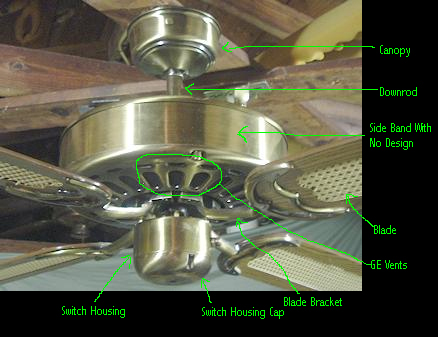
This is a standard type of ceiling fan with the motor in a housing and is
very common, and still made today, of course a little different than the one
in the picture. Ceiling fans made today, the motor housing is much smaller
and less chunky. You might have one of these. Not all standard type of
ceiling fans look exactly like this one. The vent holes, blades, and/or
canopy might be different. Also might have five paddles (Blades) instead of
four, and the color of the ceiling fan might be different. The side band
part of the motor housing also could have a design. |
|
|
 |
Standard GE Vent Ceiling
fan |
|
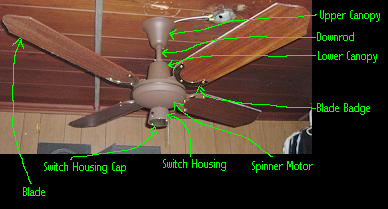
This is a spinner ceiling fan, meaning there
is no housing around the motor. This one has a lower canopy and a switch
housing. The capacitor is in the lower canopy. Manufacturers started doing
away with lower canopies by putting the capacitor in the switch housing on
spinner ceiling fans, also was the time when capacitors were being made much
smaller so they could fit in the switch housing.
|
 |
Spinner Ceiling Fan With
Lower Canopy And Switch Housing |
|
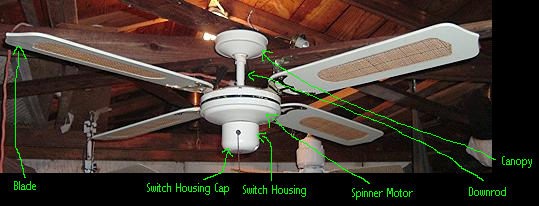
This is a spinner ceiling
fan, meaning there is no housing around the motor. As you can see this one
does not have a lower canopy.
|
 |
Spinner Ceiling Fan With
Switch Housing |
|
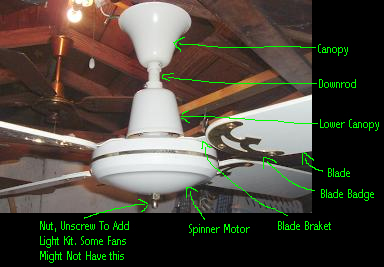
This is a spinner ceiling fan, meaning there is no housing around the motor.
This one has a lower canopy and no switch housing. Instead there is a nut.
The nut can be unscrewed to add a light kit. Spinner ceiling fans were also
made without this option, which means no nut, switch housing
or any hole on
bottom part of the motor. |
 |
Spinner
Ceiling Fan With
Lower Canopy |
|
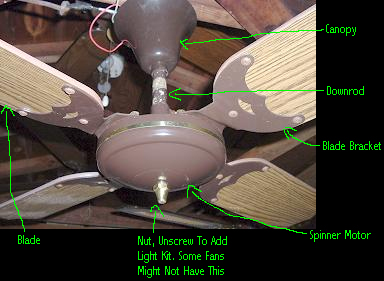
This is a spinner ceiling fan, meaning there is no housing around the motor.
This one has no lower canopy and no switch housing. Instead there is a nut.
The nut can be unscrewed to add a light kit. Spinner ceiling fans were also
made without this option, which means no nut, switch housing
or any hole on
bottom part of the motor. |
 |
Spinner Ceiling Fan |
|
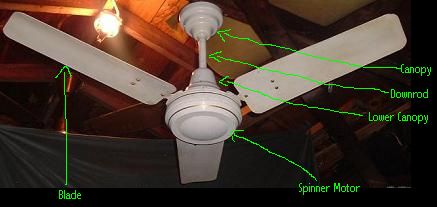
This is a spinner
industrial ceiling fan, meaning there is no housing around the motor. This
one has a lower canopy. Most industrial ceiling fans do not have a switch
housing, they do exist, but not as common. Believe it or not, I'm interested
in old three metal blade industrial ceiling fans. Back in the 70s and 80s,
industrial ceiling fans were very common in homes. All industrial
ceiling fans are spinner ceiling fans, If not, I've never seen one that
wasn't. |
 |
Industrial Spinner Ceiling
Fan |
|
|